Multilingual wedding invitations: guests from abroad read it in their own language
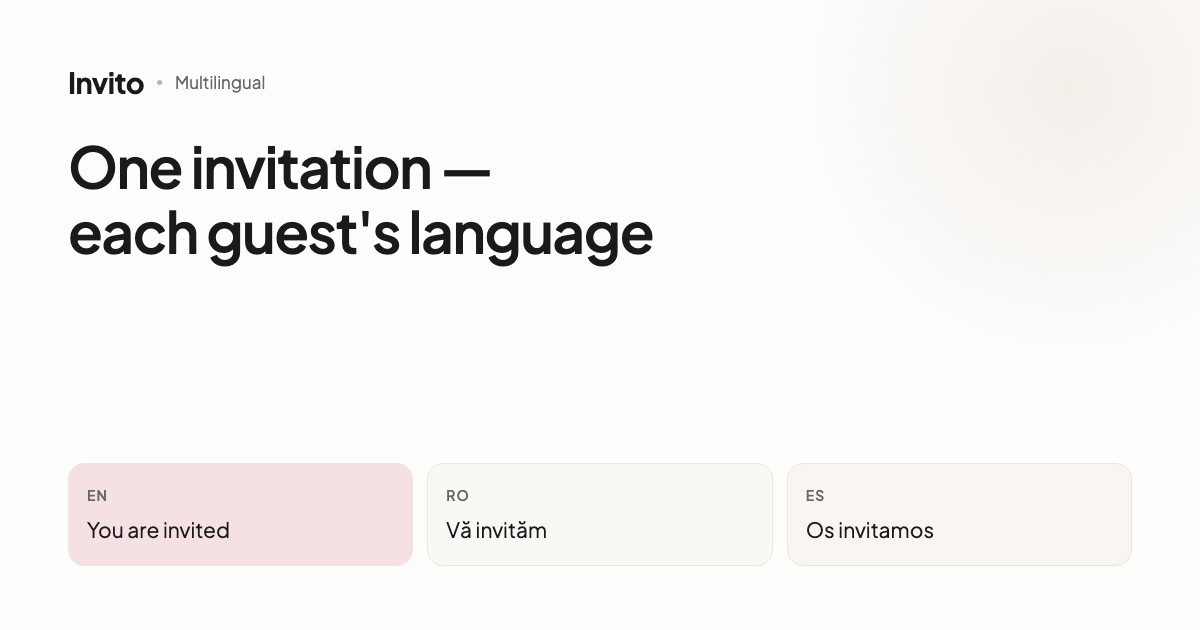
One invitation can exist in several languages at once. The language is set by the guest's link, so your relatives see the version in your language while friends from abroad see English or Spanish. The translation is done by AI given the wedding context, and a manager reviews the result before it is published. It is one site rather than several, so a change of date or address updates every language version.
A mixed crowd at a wedding is normal now. The bride is from one country, the groom from another, and the guests come from three more. The invitation has to make sense to every one of them.
The link decides the language
The language version is tied to the guest's link. You send your relatives a link in your language and your friends from abroad an English one. Each of them opens it and immediately sees their own language. Nothing to switch.
Technically it is one site, not several. That makes a real difference: when the ceremony time changes, you tell us once and every version is updated. You never end up with the new address in one language and the old one in another.
How we translate
Let's be straightforward: we don't have native speakers of twenty languages on the team. Instead, the translation is done by AI that is given the wedding context, and a manager reviews the result before it's published.
The difference from pasting your text into a regular translator lies in the rules we give the model:
- Placeholders stay untouched. The text contains substitutions such as the guest's name or the wedding date. A regular translator may translate or reorder them — and instead of a name the guest sees a broken sentence. For us this is forbidden by a dedicated rule.
- Line breaks are classified by meaning. In a poem or an address, a line break is part of the content and has to be kept. In an ordinary paragraph it is only there to look good in the original language — in another language the words have different lengths, and the same break would ruin the layout. The model classifies each line break separately.
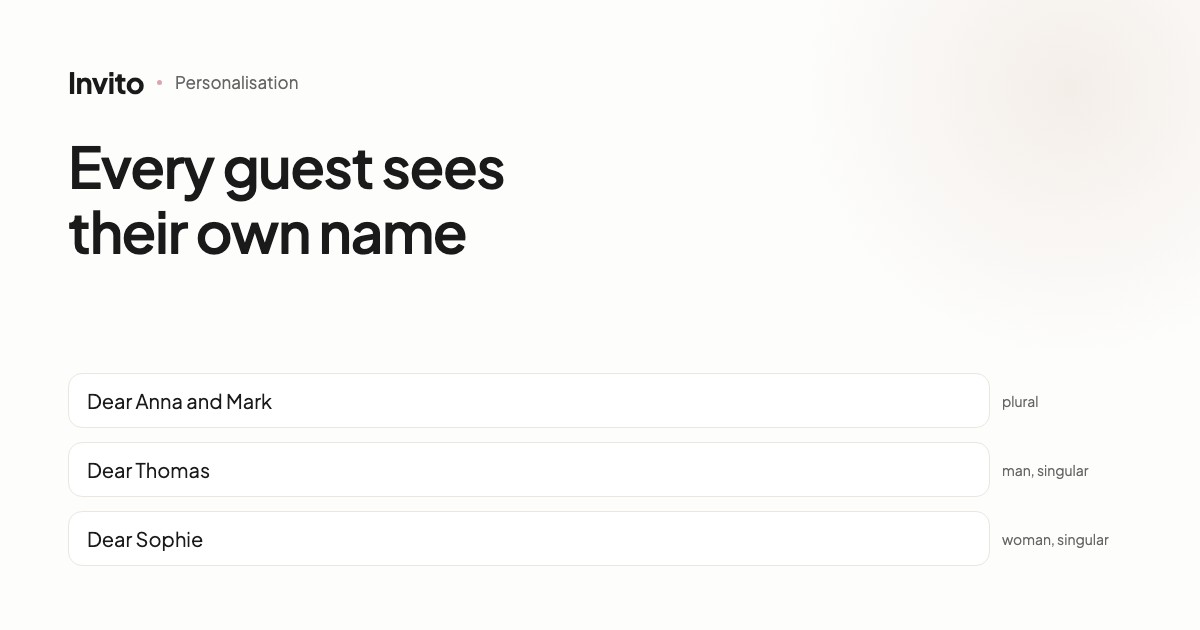
- Forms of address are generated deliberately. Languages with grammatical gender and cases need separate versions for one person, for a man, for a woman and for several guests. That's a task of its own, not a side effect of translation.
- Nothing is made up. The model is not allowed to add information that wasn't in the original.
Why a person is still needed
AI makes mistakes, and we see them in practice. The most common kind isn't a crude error but an overly free rewrite: the model “improves” a short line and adds something the couple never said.
That's why the final word belongs to a manager. They compare the translation with the original and fix the places where the tone has drifted. Special attention goes to how the guest is addressed: a mistake in a name or a verb form is the most visible, and the least forgiven.
The process is simple:
| Step | Who does it |
|---|---|
| Translation with wedding context and rules | AI |
| Forms of address by gender and number | AI |
| Comparison with the original, tone fixes | manager |
| Publishing | manager |
How many languages you really need
In our experience — two, sometimes three. The hosts' language plus the guests' language.
Typical combinations:
| Situation | Languages |
|---|---|
| Wedding at home, some guests from abroad | your language + English |
| Couple from different countries, wedding abroad | English + each family's language |
| Couple getting married in another country | your language + the local language |
There's no technical limit — the platform supports more than 20 languages, including those written right to left. But more than three rarely makes sense in practice.
What changes besides the words
Language isn't only text. The versions also differ in the details:
- Date format.
26.09.2026for some,September 26, 2026for others. - First day of the week in the calendar. Monday in most of Europe, Sunday in the US.
- Time zone. If guests are in different countries, the event time is shown correctly.
Nobody notices these details when they're right — and everyone notices when they're wrong.
What it gives you
A guest from abroad doesn't have to paste the text into a translator to understand when and where to go. They open the link and read the invitation just as they would read it in your language.
For a wedding with a mixed crowd, that's the difference between “roughly understood it” and “felt that they're expected”.
Frequently asked questions
- Do we need a separate site for each language?
- No. It is one site with several language versions. Each guest gets a link that opens the right language straight away.
- How exactly is the translation done?
- The translation is done by AI that is given the wedding context: it keeps name placeholders intact, tells meaningful line breaks from decorative ones, and produces the right forms of address. A manager then reviews the result — a person makes the final call before anything is published.
- Isn't that just machine translation, like a translator app?
- No, and the difference is practical. A regular translator works on a sentence out of context: it doesn't know that {{guestNames}} is a placeholder, or that a line break matters in a poem but not in a paragraph. Our translation receives these rules as part of the task, and a manager proofreads anything questionable.
- How many languages can we add?
- Usually two or three, which is enough for most weddings with a mixed crowd. There is no technical limit: the platform supports more than 20 languages, including right-to-left scripts.
- What if the date or the venue changes?
- You message us, and we update the information in every language version at once. The languages never get out of sync.
- Can guests get a language switcher?
- Yes, but it's usually unnecessary: the link already opens the right language. A switcher helps when a guest is bilingual or wants to forward the invitation to relatives.
Want an invitation like this?
Pick a design — we do the rest. Send us your photos and wishes, and we prepare the site, the monogram and the language versions.